Ever since the international space race began in the 1960’s, the United States of America were at the forefront as they surpassed Russia and China with their newly designed rockets. They broke several records and became the first nation in the world to invent a space shuttle that was able to make a soft landing on Earth. This was a revolutionary feat back in the early 1970s as manned rockets once launched were unable to make a soft landing on Earth, so astronauts had to crash land their space pod into the sea or ocean, which posed a great risk. This space shuttle’s cabin was built to withstand Earth’s gravitational force during descent.
NASA’s space shuttle, STS (Space Transportation System) is a partially reusable low-earth orbital spacecraft which is used to conduct various science experiments in orbit. These shuttles are actively used in the construction and servicing of the International Space Station (ISS).
The first ever successful launch was space shuttle Colombia on April 12th 1981. After five successful flights of Colombia completed back in 1983, NASA and the US government decided to include a civilian (non-astronaut) in one of its space shuttle missions. Their intention was to send a message to the common public that space travel is possible for the common public. So, they built the space shuttle challenger STS-51L for another manned space mission scheduled on January 1986.
Challenger STS-51L
The challenger space shuttle was designed to deploy a series of tracking and data relay satellites for weather study, conduct the first flight of SPARTAN-203, a shuttle pointed autonomous research tool for astronomy. SPARTAN was a program established to observe and study Halley’s comet and carry out lessons from space for students as a part of the teacher in space project and shuttle student involvement program, SSIP.
The Crew
The crew of the challenger space shuttle comprised the best-in-class astronauts with several hours of flying experience. Francis Dick Scobee, a highly experienced engineer and astronaut, was assigned as the commander of this space shuttle. Michael J Smith was an engineer, naval scientist, and astronaut who piloted the space shuttle, it was his first ever space flight. The first mission specialist Ellison Onizuka was an experienced pilot who had worked as the flight test engineer for the US Airforce. Judith Resnik, an electrical engineer, software engineer, and bio medical engineer, was assigned as the second mission specialist and flight engineer for the challenger.
Ronald McNair was a physicist and astronaut who successfully completed the STS-41-B mission. He was roped into the challenger STS-51 L mission as the third mission specialist. Gregory Jarvis, an engineer and astronaut, served as the second payload specialist. Christa McAuliffe was included to the crew as a part of the teacher in space program introduced by the US president Ronald Regan. She was specially trained for over a year to endure the harshness of the space environment and taught the basics of aerospace engineering and underwent astronaut training.
Tragedy Strikes on Launch Day
Space shuttle launches were not new to the American public as they had witnessed a few successful launches since April 1981. The challenger was scheduled for launch at Cape Canaveral, Florida on the 28th of January 1986. Many people tuned in to witness the launch through their televisions and a many others visited the launch site at Cape Canaveral, Florida, to view the launch in person. At 11:38 am, the challenger space shuttle cleared the launch pad successfully and headed towards space. Sadly, the challenger exploded mid flight at 46,000 feet in the air just 73 seconds post the launch, killing all astronauts. This horrified the onlookers and NASA employees. The debris from the explosion fell into the Atlantic ocean.
Divers and rescuers took a lot of time to locate the bodies of the deceased crew. On March 7th 1986, divers rescued the astronauts bodies successfully. The body recovery process was quite laborious and gruesome. All seven bodies underwent an autopsy but the results were inconclusive. Further research showed that some of the crew members were alive 20 seconds after the explosion. They were likely burned to a crisp slowly and painfully.
What Went Wrong?
Due to a lot of media uproar, NASA was initially unable to determine a conclusive evidence regarding the cause of the explosion and concluded it as a structural failure. Later, after subsequent investigation, it was found that due to the cold on the morning of January 28th 1986, the rubber O-ring seals on the rocket booster on the right had weakened. Instead of resealing, the O-rings allowed hot exhaust gas to escape, resulting in instant ignition and causing the fuel tank to explode.
Morton-Thiokol, the company which manufactured the O-rings had previously warned NASA that cold weather could compromise the integrity of the rings. Despite their advice, NASA proceeded with the launch tower, which was covered in icicles. NASA immediately suspended all shuttle missions after the challenger disaster. Ronald Regan launched the Rogers Commission to determine the cause of the explosion in depth. The subsequent report and findings led to the committee heavily criticizing the NASA and Morton-Thiokol for their careless attitude and ignorance towards addressing the O-ring issue. Having understood the gravity of the situation, NASA changed its modus operandi and ensured to improvise on the safety for astronauts. They terminated all private contracts for launching satellites and concluded on proceeding with fewer missions.
Lawsuits
Morton Thiokol Inc agreed to pay $7.7 million in cash and annuities to the families of four of the seven challenger astronauts as a part of the settlement. This helped the organization to avoid lawsuits in the nation’s worst space disaster as per the government documents. Subsequently, in September 1988, Roger Boisjoly, a company engineer who warned against the launch previously, raised two lawsuits against Morton Thiokol demanding $3 billion, which was dismissed by the federal judge. Despite the lawsuits which were waved off, Morton Thiokol received a very critical response from the media and the general public for their actions.
In Memory of the Crew
All seven victims of the challenger disaster were given a proper burial and tombstones were erected in their names. Most importantly, a sculpture embossed with all seven crew members was installed at NASA’s space center in Florida. The US department of education offers a scholarship named after Ronald McNair as he was an inspirational figure to many students. McNair came from a poor family background and faced a lot of racism in his life. Despite all these challenges, he emerged victorious and became a valuable asset in NASA’s space programs. McNair scholarship aims to empower and encourage students from underprivileged backgrounds to pursue doctoral work. Christa McAuliffe’s students published many articles on magazines and newspapers honoring their teacher for her achievements.
Did you know that there is a giant spacecraft that has been hovering around the Earth’s orbit since November 1998? This magnificent spacecraft is home to the best crew of astronauts and astrophysicists from around the world. It is a unique laboratory equipped with the best-in-class equipment built to study the nature of space, analyze the behavior of the human body when exposed to prolonged stays in space, and research various phenomena occurring in and around our planet. It orbits the Earth at a whopping speed of 17,500 mph, at that speed, it takes only 90 minutes to orbit the entire planet.
Origins
In November 1998, the first component of ISS was launched from a Russian Proton rocket from Bikonur Cosmodrome in Kazakhstan. With the combined efforts of the best astrophysicists and scientists from around the globe, the ISS was assembled over the next two years with increased precision and attention to detail. The first crew made it to the space station on November 2, 2000, and the initial stages of the research began in full swing. Eventually, NASA continued to add different sections to the space station with the help of Russia, Japan, and Europe, thereby completing the construction in 2011.
What Is In The ISS?
Weighing close to one million pounds under the Earth’s gravity, ISS can support a crew of six astronauts and a few visitors from Earth. It is a large facility that covers the size of a football field with five separate sectors for astronauts from Russia, Japan, United States, and Europe.
ISS consists of labs that enable astronauts to conduct scientific research, modules that are home to systems that enable the space station to function, living areas for the crew, and nodes (modules) that connect parts of the space station with each other. It also consists of solar arrays or solar panels on its sides that collect energy from the sun in order to enable optimal functioning.
Also, robotic arms are mounted outside the space station enabling radiators to control the temperature. These arms also aid astronauts to perform routine maintenance procedures of the space station in hard-to-reach areas. They also move astronauts around when they are out for spacewalks outside.
ISS is also equipped with an airlock sector that is open to the outside enabling astronauts to go on spacewalks with ease. It is an airtight room with two entrances that opens without letting air out of the spacecraft. It also acts as a docking port for new visitors to enter and receive supplies for the crew from Earth.
Why Is ISS Important?
ISS has enabled humans to live in space and explore various aspects of how the human body behaves when exposed to microgravity (the condition of being weightless). For over 20 years, astronauts have been living in space laboratories and performing in-depth research on aspects that cannot be done on Earth. The behavior of liquids, and gases under microgravity, have been clearly analyzed. It allows scientists to understand the mechanism of spacecraft when on a long-term space journey. This station has provided a perfect platform to prepare astronauts for long-term space travel and is currently being used to study the travel from Earth to Mars. It enables humans to reach the farthest points in space than ever before.
When you look at images of a nearby nebula [1] captured by space telescopes, have you ever wondered what enables you to see such vibrant images of stars with utmost clarity? Telescopes are designed in such a way that they enable us to view distant objects that are light-years away. Most modern telescopes comprise curved mirrors to gather and focus light from the night sky. However, older ones had curved lenses and clear glass that focussed light. These mirrors and lenses are known as optics, which are quite powerful and enable you to see minuscule objects which are millions of miles away. This same principle is used in monoculars and binoculars with the only difference being that they are equipped with much smaller lenses.
Larger mirrors and lenses are used in larger telescopes, this enables light to get concentrated by the shape of optics. This concentrated light is what reaches our eyes when we look into the telescope. Astronomers use mirrors and lenses that are in the right shape to concentrate the light. Any spots, scratches or uneven surfaces on the lens could greatly impair the clarity of the image. It is usually very difficult to make a perfect mirror or lens as it requires a certain level of dedication to achieve the perfect optic stability.
Now that we have understood the basic principle of how we can view images through a telescope, let us now delve into understanding the types of telescopes mainly used in astronomy.
Types of Telescopes
In the world of astronomy and star study, there are two main types of telescopes. They are reflecting telescopes and refracting telescopes.
A refracting telescope predominantly uses a lens to form an image. This is also known as a dioptric telescope which was originally used in spyglasses and later used in long-focus camera lenses. Most refracting telescopes have a lens at the front and a long tube and an eyepiece at the rear. Over the years, Astronomers have experimented with several optics and included even two or three-element lenses that could be added to other optical devices such as binoculars zoom lenses and other types of lenses. The first type of telescope was the Galilean telescope which was used in 1609 and comprises a convergent objective lens and divergent piano concave lens. This telescope provided the foundation for the modern telescopes that we see today.
Modern refracting telescopes use achromatic lenses as they allow shorter focal lengths and resolved chromatic aberration [2] issues. Most observatories use this type of telescope as it is the best suited for viewing objects in the night sky.
A reflecting telescope uses curved mirrors that reflect light to form an image. Isaac Newton invented this telescope, but this suffered from chromatic aberration. Although these telescopes face different types of aberrations, it is widely used in astronomy research due to their design variations that employ extra optical elements to enhance the image. It is widely used in infrared astronomy and is best suited in thermal infrared imaging thanks to its modified mirror surfaces or correcting lens that correct aberrations. Reflecting telescopes are usually used in planetariums and by people who take up star gazing as a hobby.
Hubble Space Telescope
Space telescopes on the other hand are in a whole other league. They are designed with such precision and perfection that they would offer maximum zoom capacity with enhanced clarity. NASA’s Hubble space telescope was the second space telescope launched, with the first being the Orbiting solar observatory, which was launched in the year 1981 to study the Sun. It usually takes nearly a decade to build a space telescope as it demands years of research and intense work with the mirror to provide the best possible resolution ever. Optics experts and astronomers worked for years to construct a 13-inch-thick blank mirror made from ultra-low expansion glass.
When the Hubble was launched in the year 1990, astronomers and star gazers marvelled at the very sight of its images. With no light interference or any other obstacles, the telescope was able to show us amazing images of our universe, which baffled everyone. The whole world was star-struck after having witnessed the marvellous universe in great detail. The Hubble comprises an optical tube assembly along with computer systems and data processing units that helped to calibrate the telescope. It was also fitted with a state-of-the-art integrated camera that enabled to capture of the images in full resolution; this camera is a wide-field planetary camera. The telescope was carried into orbit by the STS-31 space shuttle. In the subsequent missions, NASA had to visit outer space to make a few corrections to the telescope as it faced a few challenges in its initial days. Take a look at some of the images taken by the Hubble space telescope.
Hubble’s Deep Feild view of Space
Pillars of Creation, Eagle nebula
James Webb Space Telescope
With advancements in modern science and astronomy, there was a rising demand to view our universe in much more detail. The Hubble telescope was a bit dated and not advanced enough to fuel the curiosity of astronomers. NASA launched the Spitzer Space telescope in 2003, fitted with an infrared array camera, an infrared spectrograph, and a multiband imaging photometer. This telescope enabled astronomers to view a vast nursery of galaxies and nebula with increased precision, thanks to its infrared powered camera. One of the most popular images captured by this telescope is of the Helix Nebula.
Helix Nebula Captured by the Spitzer Space Telescope
After much contemplation and 20 years of research and hard work, NASA launched the James Webb Space Telescope. As of date, this telescope is one of the most powerful space telescopes ever launched. The main intention of launching this telescope is to enable scientists to view further into the depths of space and study exoplanets in detail. This telescope has the ability to view debris disks and infrared bands which are unable to be detected by existing space telescopes such as the Hubble. The James Webb telescope is equipped with a wide range of advanced instruments for easy calibration and increased accuracy. This telescope also has the capability to see further into the universe, perhaps helping us understand more about the origins and the first formation of galaxies. This telescope was launched into space on 25th December 2021. It is not undergoing calibration and final testing and is soon to show us the marvels of our universe. Here are two images that were taken during testing.
The image on the right was captured by the James Webb Telescope while testing and the one on the right was taken by SpitzerA comparison image between Hubble and James Webb
With increasing advancements in astronomy and optics, we are sure to receive a visual treat from the James Webb telescope. So, hold on to your hats for more amazing stellar images of our universe.
Glossary
[1] Nebula– A cluster of interstellar clouds comprising cosmic dust, Hydrogen, Helium, and other ionized particles. When these clouds bind together due to the force of gravity, they form stars. (This process occurs over a few million years.
[2] Chromatic aberration– A phenomenon where light rays passing through a lens focus at different points, depending on their wavelength
One of the aliens that pointed a rifle at Ankita spoke, “Get back in the cryogenic chamber, human; I don’t have time to put up with your nonsense.”
Just as Ankita recovered from the initial shock, she was hit with yet another shocker as the alien spoke in English.
“Err, um, sure, I will get back into the chamber, but it appears that one of the pods has malfunctioned. That’s the reason why I am here.”
“Hmm, I see, looks like it seems to be an issue at our end.”
The alien was interrupted by a message from one of their superiors stating that they needed to speak to Ankita now. Thankfully, luck was on Ankita’s side as she was summoned to the headquarters for questioning. She was escorted by a group of alien soldiers to a large room that resembled a conference hall, and there was a holographic panel with images and languages that seemed so foreign. In the hall, they met an older alien wearing different attire, which resembled the uniform of an army general. The alien spoke.
“Hello there, I am Urru, the Leader of interplanetary relations representing the Kafinian race, and this is the planet Neathor; I presume that your name is Ankita, right?”
“Yes, but I demand to know why my crew and I have been captured and are being detained against their will!”
“We have been closely following you humans and had received a very strong radio interference from your spacecraft a few days ago. This is a threat to us, so we had to pre-emptively take action by capturing you all before you attack.”
“What are you blabbering? Before we attack? Have you lost your mind! We don’t even know that you exist until now, and you have concluded that we have planned an elaborate attack on your kind! This is preposterous!” Shrieked Ankita.
“Yes, if we receive a radio interference, we interpret it as a threat! Don’t you do the same as well?”
“No, absolutely not! The radio interference occurred when some space debris hit our space station. And it was just an accident.”
“Oh, my bad, it looks like this was all a huge misunderstanding; I shall set you and your team free. Apologies for this mishap; we never knew that radio interferences happen as accidents in your world. Here, we take that as a threat.”
“So much for that; you have infuriated us with your heroic antics. Now let us go!”
“Hey, calm down, Ankita; it’s an honest mistake that could happen to anyone.”
“Hmph!” Ankita looked away with a smug expression on her face.
“Aren’t you curious to know more about us?”
“All right, let’s just put everything aside for a bit and get to understand each other Urru.”
“That’s more like it Ankita. Like I told you commander Fradut, humans are just like us; quite curious.”
Urru began explaining to Ankita that they were one of the largest and longest surviving species in the universe. They came into existence around 5 billion years after the big bang and have slowly evolved as a civilization over billions of years. They were able to make the most of their surroundings and began colonizing various planets in their galaxy over time. They were also able to visit places that are hundreds of light years away from their home galaxy through warp drives [1].
“Oh wow, you are an 8-billion-year-old civilization, boy; it must be impressive.” Ankita was filled with amazement.
“Yes, Ankita, we have been able to thrive as a civilization and stand the test of time thanks to our adaptable nature. The secret to our existence is our ability to adapt to change. This applies to all living species thought the universe. Our race is known as the Kafinian race; it is named after Kafin, which is an extinct species from which we evolved. We have also been through a similar path as the human race, from living in small caves, building houses, and inventing machines.”
“Hmm, I see. Can you tell us how you were able to invent new technology, find ways to travel long distances and make scientific breakthroughs that we humans cannot achieve in the present day? Tell us more, Urru.”
“Well, I can’t tell you how we advanced from a technological standpoint as it was so far back in our present time that we have lost track of it. But one thing that we know for sure is that there was a huge war somewhere between 650 to 700 million years after we first existed. This war had been a huge turning point for our species, and we were able to learn a lot from it and unite together.”
“Oh boy! It should have been a devastating war for you all; tell me more.”
“Around 7.6 billion years ago, our race was constantly competing with each other. Our ancestors had created a lot of divisions among ourselves, and we were split into 6 different civilizations; in your world, they are like countries. Among those civilizations, some of them had further subdivisions on the basis of clan, religion, political ideologies, etc. There was a lot of turmoil due to this. Two civilizations, in particular, claimed superiority and constantly oppressed the remaining four. The oppressed civilizations were initially unable to fight on par with the other two as they had fewer funds and military equipment.”
“The remaining four civilizations united and gathered enough funds to destroy the oppressors. This resulted in an all-out civil war on our planet and nearly 90% of all life on Neathor was wiped out. Neathor is our home planet, which is around 60 lightyears away from Earth.”
“Oh goodness me, how were your ancestors able to cope with such a disastrous event, Urru?”
“Well, obviously, it didn’t happen overnight; you see, Ankita, as 90% of Kafinians were killed in that deadly war, we found it increasingly difficult to develop from there as 500 million years of technological evolution was lost and had to be rebuilt from scratch. Our ancestors began building technology slowly with reference to the previous blueprints that were stored safely in an underground vault. It took nearly 200 million years to get back.”
“Hmm, this is great, Urru; looks like that civil war and global extinction was a wake-up call for the Kafinian race to bucker up.”
“Yes, Ankita, ever since that, we have learned to live despite differences among our people. Whenever a minor dispute arises among two groups, we will be reminded of that horrific war that nearly wiped us out, and we will stop the dispute then and there and begin to negotiate diplomatically. We have a large council called the Kafinian collective, which works on ensuring peace across our galaxy.”
“Wow, we have a lot to learn from your kind Urru. Thank you so much for sharing your journey.”
“The pleasure is all mine, Ankita. Here is the location of our home planet Neathor in the milky way galaxy. With the current speed of your technological advancements and space travel, it would take you at least another 750 to 1000 years to travel to our planet within your lifetime.”
“Urru, don’t pull my leg, man.”
“Aha, Nah, don’t worry, dear Ankita, we will visit you sometime soon. Looks like your crew has come around; I am sure you will have a lot to catch up with.”
“Thanks, Urru, See you soon, bye!”
“Bye, Ankita, and listen, one important thing, don’t ever tell anyone on Earth that you have met us; it could lead to a lot of confusion and utter chaos.”
“Understood, Urru, bye.”
Ankita and her team were escorted back to Earth and dropped off safely by the Kafinians. She had a lot to say to her crew. Most importantly, the crew had learned a very important lesson it is that our differences have to make us stronger as humans and that we must never let our differences get the better of us as it could lead to our downfall.
Glossary
[1] Warp Drive- Warp drives are spacecraft that enable people to travel faster than the speed of light by bending the fabric of space to create a bridge across and unbending it back. In this manner, the spacecraft will be in a warp bubble, unaffected by space-time, thereby enabling it to travel faster than the speed of light. This is a science fiction concept. Refer to the link below for more information on warp drives.
I am sure that there has been a time in your life when you looked up at the stars in the night sky and thought to yourself. Hmm, I wonder what makes them shine so brightly? There must be some secret behind it. Well, it’s no secret; it’s science! For centuries, stars have been used widely in poetry, essay, children’s rhymes, and lullabies. We have always gazed up at the night sky and tried to identify the constellations. Oftentimes, we are able to identify some prominent stars which are closer to Earth as they usually shine brighter. Let us now delve deeper into the cosmos and understand how these wonderful twinklers get their shine.
How are Stars Born, and what are they made of?
Stars are massive gas giants, not the ones like Jupiter but the ones which are way more massive than Jupiter. Did you know that it requires the mass of 70 Jupiter-sized planets to form the smallest star? 70 Jupiter-sized planets are the smallest amount of material that is enough to trigger nuclear fusion to qualify as a star. This type of star is known as a red dwarf. To understand the principle of star formation, we first need to understand the key concepts of nuclear fusion [1], nebula, and the influence of gases like Hydrogen, Helium, and oxygen.
Nebula
A nebula is a large accumulation of gas and dust in the fabric of space. Gravity influences this nebula, and the gas and dust begin to shrink and divide into small balls which look like swirling clumps. When each clump becomes ball-shaped, they continue to shrink the material, which begins getting hotter. Once the temperature reaches 10 million degrees centigrade (1 crore), an explosion would occur, thereby resulting in a nuclear fusion. When this fission starts consequently, and at a large scale, a new star is born. There are other ways how a star can be born; one such way is through a supernova explosion (which will be covered in this article), where the death of a massive star gives rise to a new high-density star known as a neutron star.
The Life of a Star
Learning the life of a star would be quite interesting as it delves into various aspects which could broaden the perspective that you have about our universe. It will also help you see our Sun in a new light and understand how its life was and will come to be in the distant future. The life span of a medium-sized star such as our Sun is around 5 billion (500 crores) years. Larger stars would have shorter lifespans; this is because their energy would burn out quicker. Similarly, stars that are smaller than our Sun tend to last longer. Have you ever wondered why stars don’t seem to change at all? A star would look the same to you now just as how you had observed it when you were five years old. This is because your lifespan would be like a second to that of the lifespan of a star.
The Birth of a Star
Not all stars follow the same path; their path would depend on the mass of the star or how much gas was collected and collapsed to form that star. This gas would serve as fuel for the star. In a nebula, when nuclei of an atom collide with enough energy, there would be a large electromagnetic repulsion between them. The strong nuclear force would take over, and the nuclei would fuse, with a small fraction of their mass converting into energy. Only when nuclei collide and fuse into the core of a star will they release enough energy to counteract the gravity crushing inward. The matter that forms a star determines the amount of fuel. With a variety of other factors, the lifetime of a star can be determined.
As we now know that any star begins from a large cloud of gas and dust; this material needs to be at least a few lightyears across. During the earliest era of star formation, this material would exclusively be Hydrogen and Helium. This was what existed in the brief 17 minutes after the big bang nucleosynthesis [2]. Hydrogen and Helium collect due to gravity and push inwards as it contracts. In this process, immense heat is generated, resulting in a nuclear fusion. This entire process is not immediate as it occurs over a few million years. A yellow or red main sequence star will be born in the process of the fusion reaction, and the glow will be the result of this reaction happening in a nearly endless cycle.
The Red Giant Phase
As long as there is hydrogen to fuel the nuclear fusion reaction, the star will continue to shine over a few billion years, depending on the mass of the star. Once the hydrogen fuel begins to deplete, the core of the star will slowly begin shrinking. When the core starts to shrink, it will become much hotter, resulting in the hydrogen fuel burning faster. The fast-burning fuel will result in extra energy released by the reaction, which radiates outwards, resulting in the outer layers of the star being pushed away from the core. This process would result in the star’s outer layers expanding, making it appear like a red giant. When the outer layer cools, the star becomes red. The star will continue to expand until most of the residual fuel is burnt. A star like our Sun will reach this stage of the life cycle around 5 billion years from now. At present, our Sun has already lived 50% of its life. A star will typically stay a red giant for around a billion years.
A Red Giant
White Dwarf- The Death of a Star
Yes, even stars die out eventually, but they would have lived a glorious life of 10 billion years (1000 crore) before they die out (This is for a medium-sized star such as our Sun). After all the reserve hydrogen fuel in the star depletes, the core begins to get even smaller and even hotter. This results in a helium flash phase. Wherein the star becomes so hot that it begins fusing heavier helium nuclei into larger nuclei through a process known as triple alpha. This means that the star has a whole new fuel other than the one that it burns for billions of years. This results in the star starting to pulsate as it runs to the final energy fuel. At this point, the star starts to contract and becomes smaller, hotter, and appears blue as most of the Helium has fused into larger nuclei. The core then becomes mostly carbon and oxygen, with a shell of Helium and hydrogen around it.
At this phase, the star has very little material left to burn, and the core will collapse. This results in the star expanding to a red giant once again until its last bursts of energy eject the outer shell. Once the outer layer of the star dissipates, only the core, which is roughly the size of our Earth, will remain. This core will gradually cool due to a lack of fuel to burn as it is not hot enough to fuse carbon or oxygen nuclei. This results in the core contracting further until the star appears to be white, earning the name “white dwarf.” This white dwarf phase would last for 10s or 100 billion years until eventually further cooling and becoming a black dwarf. At present, there are around 8 white dwarf stars discovered among hundred-star systems that are closest to our Sun. There are no known black dwarfs in our universe, as it would take trillions of years for a white dwarf to reach that stage, and our universe is just 13.8 billion years old.
A white dwarf
Planetary Nebula- The Circle of Life
Now that we have covered the life cycle of a star let us understand a few things that influence the birth and death of stars. During the red giant phase of a dying star, the shell that ejects from the core is known as a planetary nebula. The name could be misleading as it didn’t appear from a planet; it was because there was confusion during its discovery. A planetary nebula comprises large gas and dust particles, which are nothing but the remnants of a dead star. This gas and dust will become available to join another nebula in the vast universe and form yet another star.
Planetary nebula
What Happens to Larger Stars?
A star that is over 15 times the mass of our Sun is known as a high-mass star. These stars have much shorter lifespans ranging between 100 million years to even 10 million years. As mentioned before, the larger the star, the shorter its lifespan. High-mass stars usually die out with a bang, which is known as a supernova. Larger stars are formed by larger gas clouds contributing to more mass, which implies more gravity. In these starts, the force pushing inward will be much stronger, resulting in the star being much hotter. This results in faster fusion, generating a great outer pressure to counteract the inward pull of gravity. This type of star is known as the main sequence star, which appears big bright, and blue.
During the last stage of the main sequence star, the fuel runs out, and the core contracts and heats. This results in the star becoming a giant star, as in the case of low and medium-sized stars. However, when the core of a high-mass star begins to compress, it becomes much hotter than a star the size of our Sun. When the core compresses, it forms not only Helium, Carbon, and Oxygen but also Neon and Silicon. These layers are separate and pushed down on the super-hot core, which turns the core into iron. Each layer performs a particular type of fusion until no fuel remains.
A Supernova Explosion Occurs
The core of the star comprises iron nuclei which are so stable that further fusion would release no more energy. When this occurs, gravity wins the fight as there is no longer enough fusion reaction to counteract the force of gravity. All of the outer layers bounce off the core in a single second, resulting in a large massive explosion ejecting all the heavy nuclei and the remaining fuel into outer space. This explosion is what is known as a supernova. Here is a better way to understand it, if you compress an object like a small iron ball or marble using a hydraulic press, the marble ball would eventually explode due to the pressure leaving dust and debris. This is the force of compression at a small level, but the compression that triggers a supernova explosion is much higher.
Artist’s depiction of a supernova
A supernova explosion is known to be the most violent and energetic phenomenon in the universe. The explosion would be brighter than the entire galaxy that they belong to. It is so bright that its glow would be visible through the naked eye even if you are hundreds of lightyears[3] away from the explosion.
The explosion of a supernova does not leave behind a white dwarf star, unlike low-density stars. If the core of the star before the explosion was between 1.4 or 3 solar masses, the core would not be able to support itself against gravity and will collapse. This collapse will be so powerful that all the electrons will squeeze into protons such that they combine to form neutrons. The shockwave from this event is the supernova. The remnants would be a ball of neutrons bunched up together, which make a large atomic nucleus the size of 20 km in diameter. This resulting core would be so dense that a teaspoon from it would weigh a whopping 10 million (1 crore) tonnes. This core is what is known as a neutron star.
If the core of the resulting neutron star from the supernova is above 3 solar masses, the outward pressure of neutrons pressing against each other (neutron degeneracy pressure) will result in neutrons being crushed together to a single point of infinite density. This single point of density is what is known as a black hole.
Conclusion
Now that we have learned the lifecycle of a star and the birth and death of stars, I will be covering the types of stars in my upcoming articles. Scientists are still on the road to researching different types of stars and are on the verge of discovering new principles that would influence future events in our galaxy. We are still in the infancy stage, and there is a lot more to understand about stars. Now you can gaze at the night sky, knowing how these wonderful twinklers came to life and how they would die. It’s all a circle of life; when one star dies, its remnants (planetary nebula) will influence the birth of another beautiful star.
Glossary
[1] Nuclear fusion– Nuclear fusion occurs when two large nuclei in an atom merge together to form a larger, heavier nucleus. In this process, a lot of energy is released as the overall mass of the resulting nucleus is less than that of the two original nuclei. This leftover mass translates into energy.
[2] Nucleosynthesis- The creation of atomic nuclei at the center of atoms which comprise protons and neutrons. This process occurred within the first few minutes of the big bang.
[3] Lightyear- Distance traveled by light in one year
Jayshree was on her way back from work after a long shift. As she was walking back home, she looked up at the sky and noticed a jet aircraft speeding upward leaving a long stream of smoke in the process. She went into deep thought and wondered how aircraft and rockets are able to produce enough energy that enables them to soar high into the sky and leave the Earth’s atmosphere. She pulled out her smartphone, opened YouTube, and began watching videos explaining rocket propulsion. However, to her dismay, none of those videos seem to explain the concept clearly. That’s when it struck her, what’s better than to ask her boyfriend, Rupesh, who worked at the ISRO space station at Sriharikota as a senior engineer.
When Jayshree reached home, she took a bath and prepared Dosa and Kadai mutton gravy. She finished dinner and decided to call Rupesh and ask him about the question which has been eating her head for the past few hours. She opened Google Keep on her tab to take notes and called her boyfriend.
“Hi babe, how was your day sweetie? I hope all is going well.”
“Everything is going just fine babe, it has been a rough day at work today, as the Chief of Defence visited the ISRO station. We had to keep everything in check and ensure that they were all in order.”
“Oh I see, I hope you are less stressed out now, cause I really need you to explain to me about the science of rocket propulsion.”
“Wow Jayshree, I thought you were not much into the stuff that I do. Anyways, I am all fine and am ready to explain to you, babe.”
Rupesh was quite excited to see that his girlfriend had gained a sudden interest in his line of work and most importantly, was eager to know about rocket propulsion.
What is Rocket Propulsion?
Rupesh cleared his throat and began the lesson, “Just like how you light up a firework during Diwali, rockets work in a similar mechanism to that but with a lot more changes with regards to fuel, combustion method, and other related principles. Let us delve into these concepts step by step.”
“Newton’s third law of motion plays a pivotal role in understanding the principle of rocket propulsion. This states that force exists in pairs. Let’s say an object A exerts force FA on another object which is B. Then B simultaneously exerts a force FB on A, with two forces being equal and opposite. FA= -FB. There are three key factors which contribute to the rocket’s acceleration which are, the rocket’s mass, the exhaust velocity, and the rate at which the exhaust is ejected.”
“In order for a rocket to escape Earth’s gravity, the exhaust velocity needs to be proportional to the gravity of Earth. In other words, the velocity and force exerted by the exhaust need to be powerful enough to counter the gravity of Earth. The force used by the rocket is driven by the fuel which is combusted and forcefully ejected from the exhaust that an equal and opposite reaction occurs.”
“Hmm, I see so that’s how the theory of rocket propulsion plays in. Now can you please elaborate on the components of a rocket?” Asked Jayshree.
Rocket Propellent and its Types
“Jayashree, there are two main types of rocket propellants used in rockets. One is the liquid propellant and the other is a solid propellant. A rocket that is powered by a liquid propellant contains liquid fuel such as liquid oxygen, liquid nitrogen, and an oxidizer. The liquid oxidizer is present on top, with the fuel tank below it, and the pumps, which are below that. The pumps are responsible to carry the fuel and the oxidizer to the combustion chamber, which is right below the exhaust. Since there is no oxygen in outer space, rockets need a liquid oxidizer to ensure combustion as fire cannot burn without oxygen. Liquid propellant-powered rockets are mainly used on space shuttles and unmanned missiles to place satellites in orbit.”
“You have explained it so clearly Rupesh, can you tell me about solid propellant rockets?”
“Of course, Jayshree, you see, solid propellant rockets mainly comprise of two components, which are the solid oxidizer and the solid fuel. The solid fuel oxidizer is a mixture of ammonium nitrate and ammonium dinitramide, which is present in a cylindrical hole in the middle of the rocket. The igniter is used to combust the propellant surface and the hole in the middle acts as the combustion chamber. These rockets comprise a hot exhaust choke which is also found in automobiles. This hot exhaust is choked and the exhaust is expelled from the exit.”
Rocket propulsion types
Rupesh continued, “Now that you have learned about the principle of rocket propulsion and the types of rockets, you need to understand what are the factors which influence the rocket’s acceleration Jayashree. You see, the acceleration of the rocket will be greater with the exhaust velocity of the gases being greater than the rocket. Also, the acceleration is greater if the fuel in the rocket burns faster. As the mass of the rocket decreases, the acceleration will be greater, that’s why rockets tend to go faster as they reach the outer layers of the Earth’s atmosphere. This is because half of the fuel would have got burnt, thereby reducing the mass of the rocket.”
Conclusion
“Thanks, Rupesh, you are such a charmer, no wonder I fell for a rocket enthusiast like you. I am so glad that you took the time to explain this, you made complex rocket science seem like a walk in the park.”
“The pleasure is mine babe, I would love for you to visit Sriharikota sometime, I would give you a full-on tour of the place.”
“That would be awesome babe, now that my newfound interest is about science, I would love to visit ISRO soon. Let our next date be amongst large rockets ready to leave the Earth.”
“Absolutely Jayashree, I would love that. And also, always remember, there is always a lot of research going on in the field of rocket science. Did you know that scientists like us are working towards finding different propulsion systems and nuclear-powered rockets? Fossil fuels are going to go extinct in a couple of decades and we need to find new ways to reach outer space.”
Ankita Dikshit was an Astronaut and the Head of the cabin crew at the International Space Station (ISS). She was an American whose grandparents migrated from India a long time ago. She was regarded as the most talented and highly skilled person in resolving issues even by the chief technicians at NASA. She held multiple PHDs in various subjects related to astrophysics, rocket propulsion and spacecraft engineering.
It was another mundane day in the international space station, Ankita was conducting routine checks and monitoring the performance of the engineers. Robert, the Chief Technician of the ISS asked her,
“Hello Ankita, how are the stats looking, all good?”
“Hi Robert, yes everything seems fairly fine for now, we have got a couple of things to address at deck T-9. Looks like there has been a minor hull breach due to the impact of space debris.”
“Ahh, the usual, let’s hope that you can assign someone to fix it.”
“Yeah, I am sure that Clive will be able to resolve this in a few hours.”
Ankita assigned Clive and two other crew members to assist him in repairing the hull breach. She briefed them about the extent of damage and asked them to take a few precautionary measures as well.
Clive and his team got to work and performed a thorough inspection of the extent of the damage. Once they were done with the inspection, they began sealing the cracks and repairing the hull breach in a meticulous manner. They had to be extra careful while sealing the breach as there is a possibility of hitting oxygen or fuel lines which are vital to the ISS’s principal functions. As soon as they finished sealing the breaches, they heard a loud thud which shook the core of the space station. Clive wondered, what in the world could have caused this sound, he immediately asked Ankita what was going on. Ankita replied.
“Clive, get yourself and your team into the spacecraft right now! There is a large unidentified spacecraft which has forcefully docked [1] our space station to itself.”
Without a moment to lose, Clive and his team made it into the space station just in time. Right before the large unidentified spaceship began to move to tow the docked ISS in the process. Ankita’s mind was in a disarray, she was wondering, how in the world could any spacecraft be able to dock itself onto the space station? The ISS does not have any hubs that enable spacecraft of monstrous proportions to dock onto the station. Just as she was carried away by those thoughts, she and her team began feeling lightheaded. They began fainting one after the other. When Ankita realized that the result of this was due to some smoke which seemed to appear from the point of docking, she fainted.
The unknown alien spacecraft used the method of warp speed [2], to commute to its home planet, which was around 16 light-years [3] away from Earth. Soon as it landed on the planet, a group of humanoid figures wearing suits and helmets which covered their faces, got into the space station, took the unconscious crew of the ISS, and put them into cryogenic pods [4].
After a few hours, Ankita woke up. For a few minutes, her head began spinning erratically and she was not in the right state of mind. After a while, she gained consciousness and began to observe her surroundings. She found herself amidst a few cryogenic pods which were tightly shut. When she saw through the peephole of those pods, Ankita noticed that all the pods contained her team members who worked in the ISS along with her. She noticed that only her pod’s circuit breaker had malfunctioned causing it to trigger it open and set her free.
Ankita saw through the glass door which overlooked a long corridor. There were humanoid beings who looked strikingly similar to humans. The only difference was that they were much taller than an average human around 6.8 to 7 feet tall, and had pale yellow skin. Ankita was quite surprised to see the striking resemblance between them and humans.
Most of the Aliens were wearing jumpsuits and happened to be conversing with each other in a formal manner. Some of them seemed to be soldiers or defence personnel, whereas some of them seemed to be officials whose suits seemed to be more formal. As she was observing the surroundings, one of the soldiers noticed her peeking through the glass door and stormed towards the door. Ankita noticed this soldier just in time and moved away from the door before it shattered as the soldier stormed in with a firearm pointed to her skull. The sound of the door shattering attracted a few more soldiers who were in the vicinity who also stormed in guns blazing. Ankita remained speechless and stood rooted at the spot with her hands up in the air.
To be continued…
Glossary:
[1] Docked- just like how ships are docked at the harbour with an anchor, a space ship can be docked to a space station. Or a large spacecraft can attach itself to a space station. The docking process is used to carry, refuel or transport the spaceship or space station.
[2] Warp Speed- Warp speed is a theory of compressing and expanding the fabric of space and time to propel an object faster than the speed of light. (This is not a proven theory and is widely used in science fiction) You can read more at the link below.
[3] Light Year is the distance travelled by light in one year. For example, if the star Proxima century is 4 light-years away from the Earth, it means that the light from that star takes four years to reach the Earth.
[4] Cryogenic pods- These are pods which are used to store humans or any other organism in prolonged sleep or hibernation. (This is also a fictional theory which hasn’t been proven yet)
The law of conservation of energy is one of Newton’s primary laws, which states that energy can neither be created nor destroyed. Schrodinger’s equation plays the role of Newton’s laws and conservation of energy by predicting the future behavior of a dynamic system. It clears the air and clarifies the crux of the conservation of energy aspect. The equation is a wave function that predicts the probability of events or outcomes. The detailed outcome is not strictly determined; however, Schrodinger’s equation is widely used to predict the distribution of results.
Who is Schrodinger?
Erwin Schrodinger was an Austrian theoretical physicist who contributed to the wave theory of matter and other aspects of quantum mechanics. For his wide array of contributions, he was awarded the Nobel prize for his contributions in 1933, which was shared by another British physicist.
Schrodinger obtained his doctorate from the University of Vienna in 1906, which helped him to accept a research post at the university’s second physics institute. He served the military in World War one and went to the University of Zurich in 1921. He was such a determined person that he published papers that paved the foundations of quantum wave mechanics well past his retirement. In his work, he described the partial differential equation that has a relationship between the equation of quantum mechanics and mechanics of the atom.
A Quick Brush up
Through the work of Albert Einstein and Max Plank, we have learnt that energy is quantized, and light exhibits wave-particle duality. Quantized energy means that the system can have only certain energies and not a continuum of energies. For instance, only certain speeds at which a car can travel due to its kinetic energy could be having only certain values. Physicist Louis de Broglie extended this duality to include matter, which is that all matter possesses a wavelength. Regardless of it being a tiny electron, a whole body, or a huge star.
An object’s wavelength is inversely proportional to its mass, which means that macroscopic objects have very tiny wavelengths. However, since an electron is so small, its wavelength becomes relevant, which is being around the size of an atom. Therefore, we can conclude that electrons can behave like waves and particles.
Wave-nature of an Electron
An electron can be regarded as a standing wave but not a linear wave. It is a circular standing wave that surrounds the nucleus. This helps us understand why the quantization of the energy of the electron is clear. This is because any circular standing wave can only have an integer number of wavelengths. With the increasing number of wavelengths, more energy will be carried by the wave. An electron in an atom can only have a discreet number set of energy levels.
When an electron strikes a proton of a particular energy, this energy is absorbed, promoting the electron to a higher energy state and increasing the number of wavelengths—contained within the standing wave.
Here, the constructive equivalence of standing waves results in covalent bonding through orbital overlap. When it was realized that electrons exhibit wave behavior, physicists were keen on finding a mathematical model that describes this behavior. In 1925, Erwin Schrodinger achieved this goal with his signature equation.
The Schrodinger’s Equation
Schrodinger’s equation is a differential equation that is hard to decipher and cannot be explained in this article as it contains arithmetic. However, let us look into the conceptual aspect of this equation. Just like how Newton’s second law states that force equals mass into acceleration, the Schrodinger equation is applicable to quantum systems by describing a system’s three-dimensional wave function, which is represented by psi.
H represents the Hamiltonian operator, a set of operations that describe all interactions that impact the system’s state. This refers to the total energy of a particle. Although this calculates the wave function, it doesn’t describe what the wave function is. Physicist Max Born proposed that the wave function has to be interpreted as a probability amplitude. The symbol Ψ tells the probability of an electron found in a particular spot.
In the double-slit experiment, the diffraction pattern illustrates the wave of probability clearly. This pattern illustrates the probability of an electron arriving at any given spot. Bear in mind that the exact location of where an electron will land cannot be predicted; only the probability of arrival at a location can be deciphered. If many electrons arrive, it is apparent that their distribution obeys the wave function.
Schrodinger’s equation computes the wave function deterministically, but the information it contains is probabilistic. This concept of the probabilistic nature of computation was a lot to handle for the scientific community to handle and still continues to be. Just like how sound waves are oscillations in an electromagnetic field, and sound waves are mechanical waves, an electron can be considered as clouds of probability density.
Interpretations of Quantum Mechanics
Schrodinger conceived this equation that helped in interpreting some concepts in quantum mechanics. There were many other physicists who interpreted quantum mechanics, some of which include Copenhagen Interpretation, many-worlds interpretation, Quantum decoherence, and Bohmian Mechanics. These interpretations are different ways of relating the wave function to experimental results and the fundamental beliefs about nature.
Conclusion
The development of quantum mechanics has surely come a long way since Schrodinger’s time, and the recent developments have made a big change in today’s scientific community. Schrodinger’s equation has paved the way for physicists to delve deeper into quantum mechanics and particle physics. Scientists can decipher the interactions of various types of particle matter and compound elements through extensive research.
Tom was a very curious teenager who loved animals and exploring the wilderness. He would often be seen camping outdoors with his buddies. One day while camping in a forest, he happened to bump into a woman who seemed to be fidgeting with a device that looked identical to a spaceship. Being a curious kid, Tom asked the woman, “what are you doing, ma’am?”
The woman was startled by Tom’s presence. “Hey, you scared my guts.” Tom said, “Calm down, I won’t bite.”
“Ha, you are a cheeky guy indeed; I see that you are holding the action figure of a T-rex in your hand. Do you want to know about the dinosaurs?”
Tom’s face lit up with excitement, and he sported a wide grin, “Yes, sure, I would love to.”
“That’s great; dinosaurs were one of the largest and the most magnificent creatures that roamed the Earth over 66 million years ago. Let’s take a dive into ancient Earth and get to know the long-extinct creatures thrived on this planet and understand their way of life.” This sparked Tom’s curiosity; he introduced himself and asked the lady again, “Hey, what is this device?”
The woman said, “Hi Tom, I am Stella, an engineer and the device you see here is a time machine; let’s hop on and meet the dinosaurs.” Whoa, this is so awesome Stella, I would love to see the dinosaurs and learn more about them.”
Tom and Stella entered the time machine, where they met a man.
“Hey there, my dear friend, I am Paul, a palaeontologist and paleobiologist who has been long studying dinosaurs for over 15 years. I would like to introduce you to some of the most popular dinosaur species that have lived in the Mesozoic era, which was between 256 to 66 million years ago. Are you ready for the journey?”
Tom Shrieked with excitement, “Yay! This is going to be so cool.”
“Well then, what are we waiting for? Let’s hit the switch.” Paul sets the time to 150 million years into the past and hits the switch. The time machine soared high into the sky and vanished into thin air.
Meeting the Sauropods
“We are here,” said Stella. Paul nodded and said, “Let me take Tom outside and give him a tour of the surroundings.”
As Paul and Tom stepped out of the time machine, they were greeted by a heard of large dinosaurs feasting on leaves from a tall tree. Tom cried out, “That the Brachiosaurus!”
Brachiosaurus
“Yes, Tom, that’s brilliant. Brachiosaurus is a species of sauropod dinosaurs that measure between 25 to 30 meters in length and are herbivores. They are long-necked four-legged dinosaurs with tiny heads and massive bodies with long tails. These long tails help them to balance properly, move and reach the leaves of tall branches. You might be wondering how these large animals would get enough oxygen to their brains. Sauropod dinosaurs had a system of air sacs and hollow cavities in most of their vertebrae. This air sac system helps them to reduce the weight of their necks and allow them to get enough oxygen.”
“Hmm, I see. Can you tell me their lifestyle, Paul”
“Sauropod dinosaurs like Brachiosaurus feed on plants and leaves on trees. They usually stick together and move as a large herd. Their hind legs are stronger than their front legs, thereby enabling them to reach higher branches and switch to a bipedal stance. While in a herd, they can use their front legs to fend off against predators. Even powerful carnivorous dinosaurs like the Carnotaur or the T-rex would not stand a chance against the crushing stomping power of a sauropod.”
“How many kinds of sauropods are there, Paul?”
“During the Jurassic and Triassic periods, there were many species of sauropod dinosaurs. Most sauropods had similar characteristics to the Brachiosaurs, but some were smaller, and a few were much larger. For instance, the Argentinosaurus was 10 meters longer than the Brachiosaurus. Some other popular sauropod dinosaurs are Apatosaurus, Vulcanodon, Mamenchisaurus, Shunosaurus, Barosaurus, and Nigersaurus. Some of these sauropods had longer necks, a slightly higher bone and muscle density with a little difference in skeletal structure. Also, all these dinosaurs that I mentioned didn’t live in the same region or the exact time; they lived a few million years apart as some evolved and adapted according to the environment.”
Sauropods
“This was really quite insightful, Paul; I can’t wait to see the carnivorous dinosaurs.”
Meeting the Theropods
Tom and Paul got into the time machine, set the date to 70 million years from the present and hit the switch. They landed in a region in South America in a relatively sub-tropical landscape. When they noticed two Carnotaurs hunting down a juvenile herbivore dinosaur, they stood rooted to the spot. Tom’s face lit with excitement, and he was about to shriek with joy when Paul shushed him and asked him to lay low.
Carnotaur
Paul then explained about the Theropod dinosaurs, spoke of their hunting habits, their constituency, and lifestyle.
“Carnotaurs are a species of theropod dinosaurs that lived during the late cretaceous period, which was just before the mass extinction of the dinosaurs. They had a large build but highly agile predators who tend to hunt in packs. They have very small arms and are bipedal in nature. When compared to other theropod dinosaurs, Carnotaurs follow a strategy to hunt down prey tactfully.”
Tom asked Paul, “why do theropod dinosaurs like Carnotaurs have small arms and large legs?”
“Theropod dinosaurs have hollow bones, three-toed limbs, and are generally classified as a group of Saurischian dinosaurs. These dinosaurs are bipedal and mostly carnivores; they were built to remain agile and hunt for prey. Some popular theropod dinosaurs include the Tyrannosaurus (T-rex), Spinosaurus, Ceratosauria, Neotheropoda, Coelophysoidea, and Carnotaurus.
Tyrannosaurus
“Hmm, are there any common misconceptions with respect to theropod dinosaurs, Paul?”
“Of course, it is widely thought that the T-rex were lone hunters, they roar in high pitched voices, and they used to target and take down fully grown dinosaurs. All these are complete myths as the T-rex always hunted in packs of three or two, they made a low-pitched grunting noise and always preferred hunting juvenile dinosaurs as most fully grown dinosaurs were harder to take down.
Meeting the Ornithischians
Paul and Tom boarded the time machine and moved a few million years into the past to sometime around 100 million years ago. They landed in an area with rich vegetation somewhere in North America.
They noticed a few Stegosauruses taking a sip of water from a nearby pond. Tom asked excitedly, “Hey don’t they belong to the Ornithischians species of dinosaurs.”
“Yes, that’s right, Tom, now can you tell me more about these subspecies of dinosaurs?” asked Paul.
“Of course, Ornithischia or Ornithischians are a group of mostly herbivorous dinosaurs whose pelvic structure and resemble that of birds. They are known to adapt to different climatic conditions, reproduce in masses, and are partly covered in feathers during their juvenile years. However, it is debated among palaeontologists as to whether they had feathers or not. Their hips also resemble that of the birds we see today, like the ostrich, for instance. Some Ornithischians are quadrupedal, whereas some are bipedal. Most omnivorous Ornithischians are bipedal, but their medium-sized forelimbs make it easier to switch to a quadrupedal stance while waiting for prey and hunting.”
Ornithischians
“Atta boy Tom, it looks like you have done your research. Well, there are a few things that you missed out on. Unlike Theropods and Sauropods, most Ornithischians species of dinosaurs differ in body structure, lifestyle, and physical characteristics. For instance, the Stegosaurs you see here lived during the Jurassic and early Cretaceous periods. They lived mostly in the northern hemisphere. They were armoured dinosaurs large in size, protected by spikes on their spine and had a broader pelvis. They were unable to run a high speed, but later evolved to Stegosauride, which had long legs that enabled them to run faster and had more resilient armour.”
Stegosaurs
“Wow, they were more like mini tanks of that time, I guess,” said Tom.
“Yep, and not to forget about the Triceratops, they were also a species of Ornithischians that came under the sub-species of Ceratopsians. They were predominantly herbivorous dinosaurs that had longhorns to fend off predators. However, not all Ceratopsian dinosaurs had horns, as some of them were smaller dinosaurs. Did you know that a fully grown Triceratops can take down a Carnotaur or even a Tyrannosaurus when confronted? Yes, if the Triceratops uses its horns to pierce the gut of a Tyrannosaurus, then the latter could bleed out and die.”
Triceratops
“Oh my god, Paul, I never knew that an adult Triceratops could take down the T-rex.”
“Yes, and also to note, some popular Ornithischians are Pisanosaurus, Ankylosauria known for their hard armour-plated back and a club on its tail, Pachycephalosauria is known for their hard heads, Scutellosaurus, and Ornithopods.
Meeting the Dinosaurs of the Sky
“Hey Stella, what say, shall we take the time ship up to the sky to show Tom some flying dinos?”
“Sure Paul, I would love to.”
The time ship soared into the sky and met the clouds. Paul asked Tom, “Hey young man, do you want to meet some winged reptiles?”
“Wow, would love to!” Tom shrieked with excitement.
As they were flying, they noticed numerous bird-like dinosaurs that flying by their side. Paul pointed out to a few of them and explained each species.
“The flying reptiles you see to the right are Pterosaurs, they were the most resilient creatures as they have stood the test of time quite well. They existed from the early Mesozoic era to the great extinction. Yes, that’s right they have survived for nearly 162 million years. They were the largest flying dinosaurs with a wing span of 10-11 meters and weighed up to 250 kilograms. While standing, they could reach the height of a modern giraffe. Their bones were hollow and air filled, similar to that of birds, with a large breastbone and an enlarged brain. Pterosaurs were intelligent enough to coordinate with their kind and engage in complex flying behaviour that helped in hunting for prey.”
Pterosaurs
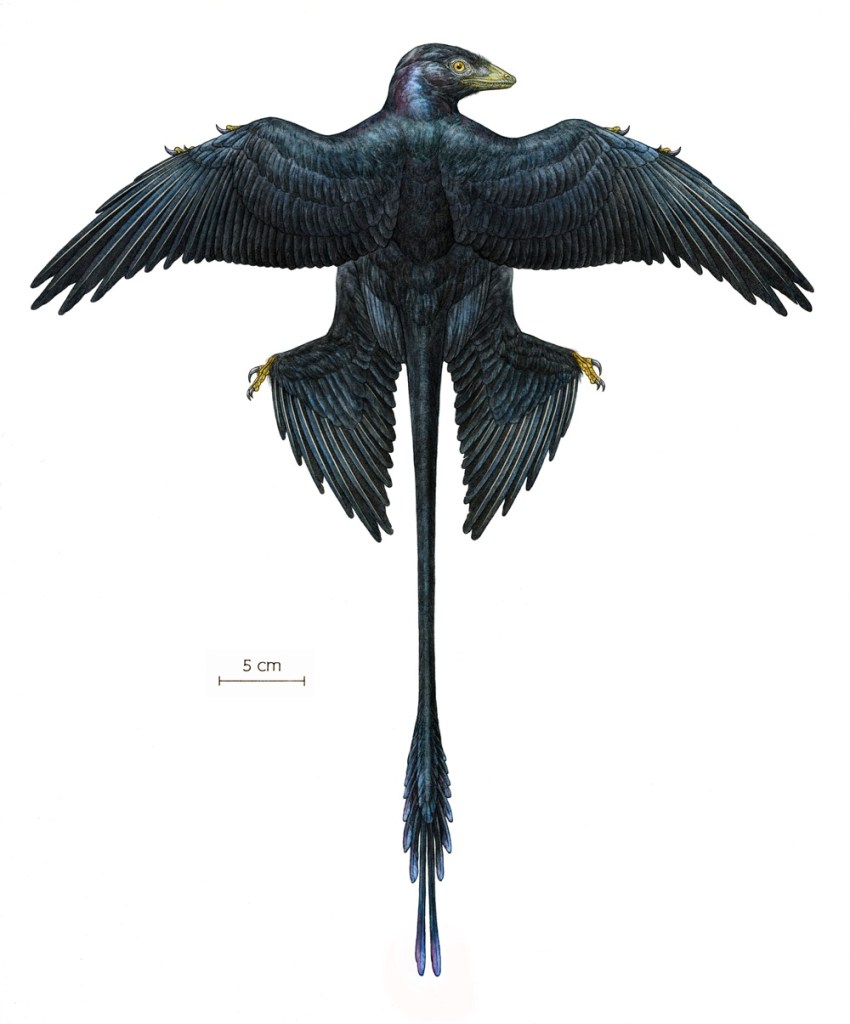
“The flying dinosaurs you see to the far left are known as Microraptors. These dinosaurs are relatively small with four wings and are highly agile in air. Due to their small size, they can make sharp manoeuvres in quick succession and evade larger predators.”
Microraptor
“The ones you see a few feet below are the Sinornithosaurus. As you can see these dinosaurs are also relatively small with feathers and weigh only 3-4 kilograms. They are known for gliding and swooping down to catch small prey just like a modern eagle. According to paleo-research Sinornithosaurus might have had a venomous bite to neutralize prey. They were highly active dinosaurs as they remained vigilant both during the day and night.”
Sinornithosaurus
“This is sick Stuff Paul, looks like there is a lot more to research on when I get back to the present.” Said Tom.
Meeting the Dinosaurs of the Sea
Paul and Tom boarded the time machine, and Stella suggested that they use it as a travel ship to go underwater and see the dinosaurs at sea. Paul felt that this was a brilliant idea and urged Stella to go ahead. They travelled to the ocean.
Stella pressed a few buttons and flicked a few switches; the time machine transformed into a mini-submarine and dropped into the water. All were stunned by the amazing sight that they behold. There were numerous large marine creatures that swam hither thither. Tom was unable to identify most species and turned to Paul for help.
Paul said, “ Hey, look, Tom, Do you see that large fish-like lizard there?
“Yes, what is it?”
“Well, that is the Ichthyosaur; they are also known as fish lizards as they resemble large dolphin-like reptiles. They lived all through the Mesozoic era and evolved differently over a period of 100-150 million years, during the Jurassic, Triassic, and Cretaceous periods. Fossil evidence suggests that they first appeared around 250 million years ago. Ichthyosaurs evolved from a group of unidentified land reptiles that returned to the sea. This is seen in mammalian land-dwelling ancestors of modern-day dolphins and whales. They were a product of convergent evolution, that is the independent evolution of similar features in species of different periods of epochs in time.”
Ichthyosaur
Just then, they spotted another dinosaur-like fish with a mouth identical to an alligator. Paul explained what creature that was.
“Hey, Tom, that’s a Pliosaur; if you observe closely, you will notice that they have crocodile-like short necks and large heads with massive toothed jaws. They are giant swimming reptiles and aren’t dinosaurs. They have an elongated head, large hind flippers and were predominantly carnivorous with long powerful jaws that had large conical teeth. Pliosaurs ranged from 4 to 15 meters in length.”
Pliosaur
“Hmm, can you tell me about the Mosasaurs?” asked Tom.
“Hey Stella, can we travel to 70 million years in the past as we are now a 100 million years in the past?” Asked Paul.
“Sure thing Paul.” Said Stella
When they reached the same location 30 million years later, Tom was able to see the Mosasaurs. Paul explained.
“Mosasaurs were large marine reptiles that breathed air, were very powerful swimmers and were carnivores like most sea fearing dinosaurs. They adapted to living in warm, shallow inland seas and gave birth to live young rather than returning to the shore to lay eggs. They ranged between 5 to 13 feet long and had a body shape similar to monitor lizards. Their bite force was so powerful that it could take down the modern great white shark with just one bite.”
Mosasaurs
“Thanks a lot for your insightful explanation, Paul; I have learnt a lot about dinosaurs living in various environments.” I would love to meet you and Stella often and go on a wild exploration to different times in the past to understand different cultures, civilizations and people.”
Tom, Paul, and Stella returned back to the present, exchanged pleasantries and contact information and went their merry way. This experience had helped Tom to draft a new thesis for one of his school projects too.
There was a time when the universe was perceived to be a rigid three-dimensional space with no flexibility. It was perceived that the region of space was highly static and unbendable in nature. However, all these ideas and theories changed when Albert Einstein did a thorough analysis of the nature of the universe and proposed a theory that has laid a highly concrete foundation that helps scientists today.
Einstein, a German-born theoretical physicist, was one of the greatest known geniuses of all time. He was known for developing the theory of relativity and made important contributions to the development of quantum mechanics. He was truly a legend as he established two strong pillars of modern physics, which are quantum mechanics and relativity.
Family Background
Born in Ulm in the Kingdom of Wurttemberg in the German Empire on the 14th of March 1879, Einstein was born to a family of secular Ashkenazi Jews. There is a widely spread misconception that Einstein flunked school, but it is quite the contrary. He was well versed in science, mathematics and was great at proving complex theorems.
At 13, Einstein became interested in philosophy became a follower of Kant’s critique of pure reason. Not to mention, Kant was one of the greatest philosophers who was quite hard to decipher. He was able to evaluate patent applications for a variety of devices, such as an electromechanical typewriter and a gravel sorter. He excelled in academics and was one of the brightest students in class.
An Emerging Scientist
Einstein was always at the top of his game when it came to science, mathematics and quantum mechanics . In 1903, he became a permanent person at the Swiss patent office, He was passed over for promotion until he fully mastered machine technology. He focused on addressing patent office related questions about transmission of electric signals and electrical-mechanical synchronization of time.
When these two issues cropped up consciously in these thought experiments, this led to Einstein’s epiphany. He concluded about the nature of light and the fundamental connection between space and time.
Einstein’s achievements had reached several ears, and he was recognized as a leading scientist and was appointed lecturer at the University of Bern. He also gave a lecture on electrodynamics, and the principal at the University of Zurich recommended him to the faculty of the newly created professorship in theoretical physics. He was appointed as the associated professor in 1909.
Achievements in Theoretical Physics
In April 1911, Einstein became a full-time professor at the German Charles-Ferdinand University in Prague. He accepted Austrian citizenship and wrote 11 scientific works. He wrote five on radiation mathematics and the quantum theory of solids.
Einstein’s zest for teaching and research did not end there; he returned to his alma mater in Zurich and became a professor of theoretical physics at the ETH Zurich. He taught thermodynamics and continuum mechanics. He took an interest in the molecular theory of heat, the problem of gravitation, and continuum mechanics.
Fleeing the Nazi regime
Einstein decided to stay in the US in 1933 and continue his research due to the violent persecution of Jews in Germany and then Austria. He undertook his third two-month visiting professorship at the California Institute of Technology in Pasadena. He then returned to Europe with his wife Elsa, and that’s when they learnt that the Nazis had raided and confiscated his personal sailboat. Knowing this, he confiscated his passport by formally renouncing his German citizenship.
The Government of the USA was quite impressed with his achievements and requested him to participate in the Manhattan Project in 1939. This project dealt with the creation of the atom bomb. Other renowned scientists like Richard Feynman and J Robert Oppenheimer were also involved in this.
Einstein became an American citizen in 1940 and settled into his career at the institute for advanced study in Princeton. He was recognized as the right individual without social barriers and became more creative and engaged in helping students in education.
Einstein’s Achievements
One of the most prominent concepts that redefined the perspective of our universe was achieved by Einstein. The concept that space was a static three-dimensional realm that was not bendable was challenged and disproved. Einstein proposed the theory of relativity, which encompassed that the nature of space-time is highly flexible, and the fabric of space can be bent accordingly. Also, the concept of time being relative was clearly explained in his theory. His formula of mass-energy equivalence is considered to be the most famous equation E=Mc2. This equation gave rise to the concept of rest energy.
Einstein provided empirical evidence of the atomic theory by clearly explaining the browning motion that confirmed the existence of atoms and molecules. He resolved the riddle of the photoelectric effect by challenging the wave theory of light and suggesting that light could also be regarded as a collection of discrete energy packets. In 1924, Einstein collaborated with Bose to predict the Bose-Einstein condensate. He also engaged in debates with Niels Bohr that brought quantum mechanics in focus. For his revolutionary achievements, Einstein was awarded the Nobel peace prize in 1921.
Conclusion
Most observable aspects of the universe and the scientific theories we know today have a strong connection with Einstein’s achievements and formulations. He gave scientists tools to mould different aspects of science, right from nuclear energy production to GPS synchronization of satellites. You would be surprised to know that many science fiction novels we read today have a deep imprint of Einstein’s theory. He has literally shaped modern science through his achievements and dedication. In fact, his theories and achievement have clearly stood the test of time and would even pave the way for future achievements in science.




 Space Age