A Date With The Dinosaurs

Tom was a very curious teenager who loved animals and exploring the wilderness. He would often be seen camping outdoors with his buddies. One day while camping in a forest, he happened to bump into a woman who seemed to be fidgeting with a device that looked identical to a spaceship. Being a curious kid, Tom asked the woman, “what are you doing, ma’am?” 

The woman was startled by Tom’s presence. “Hey, you scared my guts.” Tom said, “Calm down, I won’t bite.”

“Ha, you are a cheeky guy indeed; I see that you are holding the action figure of a T-rex in your hand. Do you want to know about the dinosaurs?” 

Tom’s face lit up with excitement, and he sported a wide grin, “Yes, sure, I would love to.” 

“That’s great; dinosaurs were one of the largest and the most magnificent creatures that roamed the Earth over 66 million years ago. Let’s take a dive into ancient Earth and get to know the long-extinct creatures thrived on this planet and understand their way of life.” This sparked Tom’s curiosity; he introduced himself and asked the lady again, “Hey, what is this device?”

The woman said, “Hi Tom, I am Stella, an engineer and the device you see here is a time machine; let’s hop on and meet the dinosaurs.” Whoa, this is so awesome Stella, I would love to see the dinosaurs and learn more about them.” 

Tom and Stella entered the time machine, where they met a man. 

“Hey there, my dear friend, I am Paul, a palaeontologist and paleobiologist who has been long studying dinosaurs for over 15 years. I would like to introduce you to some of the most popular dinosaur species that have lived in the Mesozoic era, which was between 256 to 66 million years ago. Are you ready for the journey?”

Tom Shrieked with excitement, “Yay! This is going to be so cool.” 

“Well then, what are we waiting for? Let’s hit the switch.” Paul sets the time to 150 million years into the past and hits the switch. The time machine soared high into the sky and vanished into thin air.

Meeting the Sauropods

“We are here,” said Stella. Paul nodded and said, “Let me take Tom outside and give him a tour of the surroundings.” 

As Paul and Tom stepped out of the time machine, they were greeted by a heard of large dinosaurs feasting on leaves from a tall tree. Tom cried out, “That the Brachiosaurus!” 

Brachiosaurus

“Yes, Tom, that’s brilliant. Brachiosaurus is a species of sauropod dinosaurs that measure between 25 to 30 meters in length and are herbivores. They are long-necked four-legged dinosaurs with tiny heads and massive bodies with long tails. These long tails help them to balance properly, move and reach the leaves of tall branches. You might be wondering how these large animals would get enough oxygen to their brains. Sauropod dinosaurs had a system of air sacs and hollow cavities in most of their vertebrae. This air sac system helps them to reduce the weight of their necks and allow them to get enough oxygen.”

“Hmm, I see. Can you tell me their lifestyle, Paul”

“Sauropod dinosaurs like Brachiosaurus feed on plants and leaves on trees. They usually stick together and move as a large herd. Their hind legs are stronger than their front legs, thereby enabling them to reach higher branches and switch to a bipedal stance. While in a herd, they can use their front legs to fend off against predators. Even powerful carnivorous dinosaurs like the Carnotaur or the T-rex would not stand a chance against the crushing stomping power of a sauropod.” 

“How many kinds of sauropods are there, Paul?”

“During the Jurassic and Triassic periods, there were many species of sauropod dinosaurs. Most sauropods had similar characteristics to the Brachiosaurs, but some were smaller, and a few were much larger. For instance, the Argentinosaurus was 10 meters longer than the Brachiosaurus. Some other popular sauropod dinosaurs are Apatosaurus, Vulcanodon, Mamenchisaurus, Shunosaurus, Barosaurus, and Nigersaurus. Some of these sauropods had longer necks, a slightly higher bone and muscle density with a little difference in skeletal structure. Also, all these dinosaurs that I mentioned didn’t live in the same region or the exact time; they lived a few million years apart as some evolved and adapted according to the environment.” 

Sauropods

“This was really quite insightful, Paul; I can’t wait to see the carnivorous dinosaurs.” 

Meeting the Theropods

Tom and Paul got into the time machine, set the date to 70 million years from the present and hit the switch. They landed in a region in South America in a relatively sub-tropical landscape. When they noticed two Carnotaurs hunting down a juvenile herbivore dinosaur, they stood rooted to the spot. Tom’s face lit with excitement, and he was about to shriek with joy when Paul shushed him and asked him to lay low. 

Carnotaur

Paul then explained about the Theropod dinosaurs, spoke of their hunting habits, their constituency, and lifestyle. 

“Carnotaurs are a species of theropod dinosaurs that lived during the late cretaceous period, which was just before the mass extinction of the dinosaurs. They had a large build but highly agile predators who tend to hunt in packs. They have very small arms and are bipedal in nature. When compared to other theropod dinosaurs, Carnotaurs follow a strategy to hunt down prey tactfully.” 

Tom asked Paul, “why do theropod dinosaurs like Carnotaurs have small arms and large legs?”

“Theropod dinosaurs have hollow bones, three-toed limbs, and are generally classified as a group of Saurischian dinosaurs. These dinosaurs are bipedal and mostly carnivores; they were built to remain agile and hunt for prey. Some popular theropod dinosaurs include the Tyrannosaurus (T-rex), Spinosaurus, Ceratosauria, Neotheropoda, Coelophysoidea, and Carnotaurus.

Tyrannosaurus

“Hmm, are there any common misconceptions with respect to theropod dinosaurs, Paul?”

“Of course, it is widely thought that the T-rex were lone hunters, they roar in high pitched voices, and they used to target and take down fully grown dinosaurs. All these are complete myths as the T-rex always hunted in packs of three or two, they made a low-pitched grunting noise and always preferred hunting juvenile dinosaurs as most fully grown dinosaurs were harder to take down. 

Meeting the Ornithischians

Paul and Tom boarded the time machine and moved a few million years into the past to sometime around 100 million years ago. They landed in an area with rich vegetation somewhere in North America.

They noticed a few Stegosauruses taking a sip of water from a nearby pond. Tom asked excitedly, “Hey don’t they belong to the Ornithischians species of dinosaurs.” 

“Yes, that’s right, Tom, now can you tell me more about these subspecies of dinosaurs?” asked Paul.   

“Of course, Ornithischia or Ornithischians are a group of mostly herbivorous dinosaurs whose pelvic structure and resemble that of birds. They are known to adapt to different climatic conditions, reproduce in masses, and are partly covered in feathers during their juvenile years. However, it is debated among palaeontologists as to whether they had feathers or not. Their hips also resemble that of the birds we see today, like the ostrich, for instance. Some Ornithischians are quadrupedal, whereas some are bipedal. Most omnivorous Ornithischians are bipedal, but their medium-sized forelimbs make it easier to switch to a quadrupedal stance while waiting for prey and hunting.”

Ornithischians

“Atta boy Tom, it looks like you have done your research. Well, there are a few things that you missed out on. Unlike Theropods and Sauropods, most Ornithischians species of dinosaurs differ in body structure, lifestyle, and physical characteristics. For instance, the Stegosaurs you see here lived during the Jurassic and early Cretaceous periods. They lived mostly in the northern hemisphere. They were armoured dinosaurs large in size, protected by spikes on their spine and had a broader pelvis. They were unable to run a high speed, but later evolved to Stegosauride, which had long legs that enabled them to run faster and had more resilient armour.” 

Stegosaurs

“Wow, they were more like mini tanks of that time, I guess,” said Tom.

“Yep, and not to forget about the Triceratops, they were also a species of Ornithischians that came under the sub-species of Ceratopsians. They were predominantly herbivorous dinosaurs that had longhorns to fend off predators. However, not all Ceratopsian dinosaurs had horns, as some of them were smaller dinosaurs. Did you know that a fully grown Triceratops can take down a Carnotaur or even a Tyrannosaurus when confronted? Yes, if the Triceratops uses its horns to pierce the gut of a Tyrannosaurus, then the latter could bleed out and die.”

Triceratops

“Oh my god, Paul, I never knew that an adult Triceratops could take down the T-rex.”

“Yes, and also to note, some popular Ornithischians are Pisanosaurus, Ankylosauria known for their hard armour-plated back and a club on its tail, Pachycephalosauria is known for their hard heads, Scutellosaurus, and Ornithopods.

Meeting the Dinosaurs of the Sky

“Hey Stella, what say, shall we take the time ship up to the sky to show Tom some flying dinos?”

“Sure Paul, I would love to.”

The time ship soared into the sky and met the clouds. Paul asked Tom, “Hey young man, do you want to meet some winged reptiles?”

“Wow, would love to!” Tom shrieked with excitement.

As they were flying, they noticed numerous bird-like dinosaurs that flying by their side. Paul pointed out to a few of them and explained each species.

“The flying reptiles you see to the right are Pterosaurs, they were the most resilient creatures as they have stood the test of time quite well. They existed from the early Mesozoic era to the great extinction. Yes, that’s right they have survived for nearly 162 million years. They were the largest flying dinosaurs with a wing span of 10-11 meters and weighed up to 250 kilograms. While standing, they could reach the height of a modern giraffe. Their bones were hollow and air filled, similar to that of birds, with a large breastbone and an enlarged brain. Pterosaurs were intelligent enough to coordinate with their kind and engage in complex flying behaviour that helped in hunting for prey.”

Pterosaurs

“The flying dinosaurs you see to the far left are known as Microraptors. These dinosaurs are relatively small with four wings and are highly agile in air. Due to their small size, they can make sharp manoeuvres in quick succession and evade larger predators.”
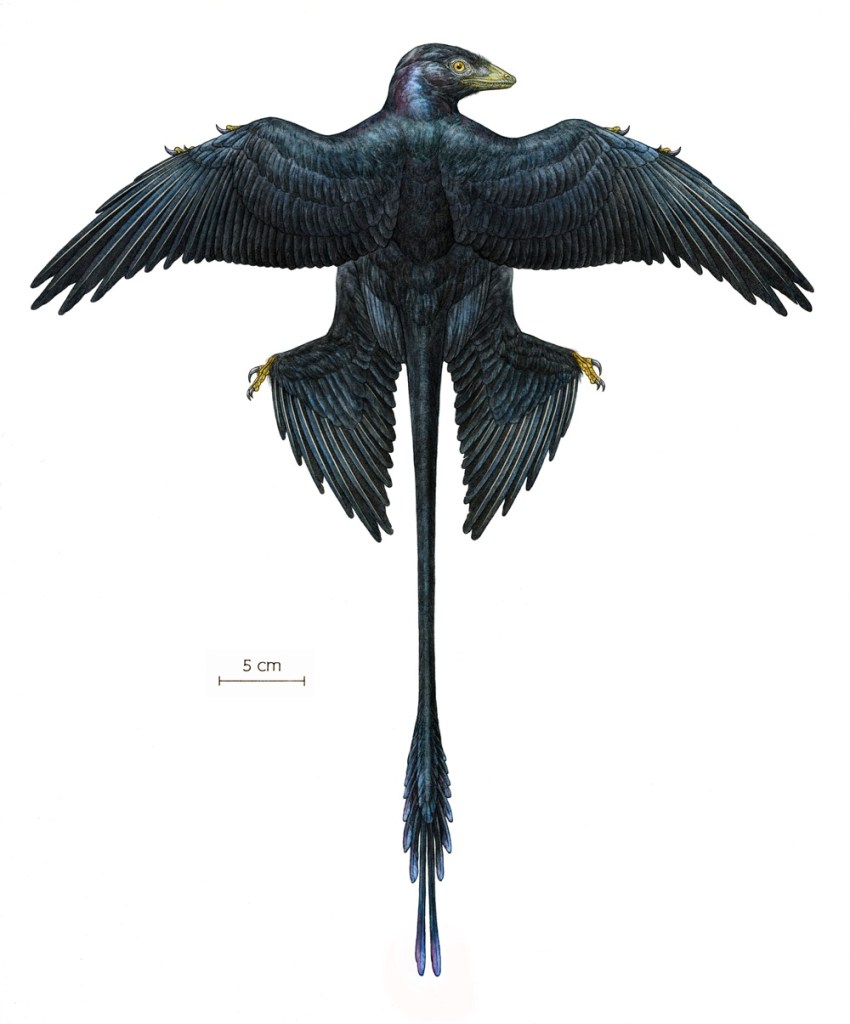
Microraptor

“The ones you see a few feet below are the Sinornithosaurus. As you can see these dinosaurs are also relatively small with feathers and weigh only 3-4 kilograms. They are known for gliding and swooping down to catch small prey just like a modern eagle. According to paleo-research Sinornithosaurus might have had a venomous bite to neutralize prey. They were highly active dinosaurs as they remained vigilant both during the day and night.”

Sinornithosaurus

“This is sick Stuff Paul, looks like there is a lot more to research on when I get back to the present.” Said Tom.

Meeting the Dinosaurs of the Sea

Paul and Tom boarded the time machine, and Stella suggested that they use it as a travel ship to go underwater and see the dinosaurs at sea. Paul felt that this was a brilliant idea and urged Stella to go ahead. They travelled to the ocean. 

Stella pressed a few buttons and flicked a few switches; the time machine transformed into a mini-submarine and dropped into the water. All were stunned by the amazing sight that they behold. There were numerous large marine creatures that swam hither thither. Tom was unable to identify most species and turned to Paul for help. 

Paul said, “ Hey, look, Tom, Do you see that large fish-like lizard there? 

“Yes, what is it?”

“Well, that is the Ichthyosaur; they are also known as fish lizards as they resemble large dolphin-like reptiles. They lived all through the Mesozoic era and evolved differently over a period of 100-150 million years, during the Jurassic, Triassic, and Cretaceous periods. Fossil evidence suggests that they first appeared around 250 million years ago. Ichthyosaurs evolved from a group of unidentified land reptiles that returned to the sea. This is seen in mammalian land-dwelling ancestors of modern-day dolphins and whales. They were a product of convergent evolution, that is the independent evolution of similar features in species of different periods of epochs in time.” 

Ichthyosaur

Just then, they spotted another dinosaur-like fish with a mouth identical to an alligator. Paul explained what creature that was.

“Hey, Tom, that’s a Pliosaur; if you observe closely, you will notice that they have crocodile-like short necks and large heads with massive toothed jaws. They are giant swimming reptiles and aren’t dinosaurs. They have an elongated head, large hind flippers and were predominantly carnivorous with long powerful jaws that had large conical teeth. Pliosaurs ranged from 4 to 15 meters in length.”

Pliosaur

“Hmm, can you tell me about the Mosasaurs?” asked Tom. 

“Hey Stella, can we travel to 70 million years in the past as we are now a 100 million years in the past?” Asked Paul.

“Sure thing Paul.” Said Stella

When they reached the same location 30 million years later, Tom was able to see the Mosasaurs. Paul explained.

“Mosasaurs were large marine reptiles that breathed air, were very powerful swimmers and were carnivores like most sea fearing dinosaurs. They adapted to living in warm, shallow inland seas and gave birth to live young rather than returning to the shore to lay eggs. They ranged between 5 to 13 feet long and had a body shape similar to monitor lizards. Their bite force was so powerful that it could take down the modern great white shark with just one bite.” 

Mosasaurs

“Thanks a lot for your insightful explanation, Paul; I have learnt a lot about dinosaurs living in various environments.” I would love to meet you and Stella often and go on a wild exploration to different times in the past to understand different cultures, civilizations and people.”

Tom, Paul, and Stella returned back to the present, exchanged pleasantries and contact information and went their merry way. This experience had helped Tom to draft a new thesis for one of his school projects too. 

The Journey of Life on Earth

The observable universe consists of over 200 billion galaxies that are home to trillions of star clusters. The probability of life existing in several stars is vast but rare; this is because several factors must be crossed off a long checklist in order for a planet to support life. The existence of microbial life in the universe has a higher probability compared to multicellular organisms. However, the existence of intelligent species in the universe has a much lesser probability due to the complexities in evolution regarding chromosomes and DNA.

Everything has a story to tell

Everything in this world, big or small, significant or insignificant, has a story to tell. Take, for instance, a pencil, right from the time it was manufactured until it withers away writing its last letter; it would have a wonderful story to share. If something as small as a pencil has such a beautiful story, just imagine what kind of a story would a 4.5-billion-year-old planet, our Earth, have to say. You may be wondering, who will be able to share the journey of our Earth? If you need to understand the history of our Earth and how life evolved, our genius Geologists are the ones who can explain it best. 

Geologists, what would people who specialize in the study of lifeless rocks know about our Earth and the evolution of life? You may ask. Yes, it’s the layers of rock that have been sedimented over billions of years that tell us the history of our planet; it is the fossils of primitive animals like dinosaurs embedded under layers of rock that tell us about life and how it evolved. Geobiologists can tell us how life began, adapted, and evolved. Geochemists can tell us the inner workings of the Earth, the mechanisms behind the geological activity, and the constituents of minerals present in rocks.

History of our Earth

We all know that our Earth was a barren hell 4.6 million years ago, but don’t we want to know how a barren world began beaming with life? The process of the Earth cooling down took over a billion years. When our planet was first formed, it spewed out hot lava, making the surface thousands of degrees hot. Over a few million years, due to the lack of atmosphere and the vacuum of space, our planet cooled down. The hot lava that cooled down formed Basalt, the first rocks on our planet that added a layer of crust on our planet. Basalt contained some important ingredients necessary for life, minerals. 

The Six Stages of formation 

From an extensive study of our planet’s rocks, Geologists have theorized that our Earth has been through six stages in its formation from the beginning to the Earth we see today. These six stages are black, grey, blue, red, white, and green. The black stage was when the planet looked black due to the sedimentation of Basalt. Meteorites that formed the earth had about 250 minerals, a starter kit containing building blocks for life. Due to intense heat and pressure emitted during the planet’s early formation, many new minerals began to form, which turned the planet’s appearance from black to grey. In the Grey period, granite became the foundation of continents. One thing that baffles Geologists is that these six stages happened in quick succession over the course of 4.5 billion years, which is fast in a Geological time scale. 

Water, the fundamental building block of life 

The blue stage is the most important stage as this was when the first organisms began to form due to water and oxygen in the atmosphere. There has always been a never-ending debate on how water formed on Earth, with several theories floating about. Research has led experts to the discovery of hydrogen signatures in meteorites that matched the rocks found on the Earth’s mantle. With a lot of oxygen bound up with minerals, which could be liberated under certain circumstances and combined to form water. This process happens in magma, molten rock containing dissolved water that rises from the mantle to the surface in volcanos as a hot spring. As the pressure in the atmosphere fell, water vapours evaporated into the atmosphere as steam condenses and falls back on Earth as rain filling our oceans and rivers. 

Geologists discovered Zircon, an essential mineral present 4.3 billion years ago, which could have formed only in the presence of liquid water. Experts debate whether microscopic life could have existed 4.3 billion years ago as the first forms of life were discovered in stromatolites, the earliest fossils of life that existed 3.5 billion years ago.

Proterozoic era, the formation of single-celled organisms 

In the red stage of the Earth’s evolution, the atmosphere was rich in nitrogen and carbon dioxide but lacked oxygen. Microbes that were floating in water or stromatolites began changing everything, turning the Earth red. The first single-celled organisms were cyanobacteria that thrived in trillions. These microbes began living off the sun’s energy through photosynthesis, which led to a rise in oxygen levels in the atmosphere. Oxygen was a new gas to our planet back then; with the early oceans filled with dissolved iron, the new oxygen reacted with iron and began to rust, which gave Earth a red appearance.

With Earth’s new continents forming and breaking apart, there was dramatic extremes in the climate. Our planet froze into ice and snow, thereby making it appear white. In the white stage, most life was nearly wiped out with only a hand full of single-celled microbes living near dying volcanoes where there was warmth. These volcanoes spewed out carbon dioxide that heated up the Earth, and over the course of a few million years, ice began melting due to a natural greenhouse effect. 

Paleozoic era, the formation of complex multi-cellular organisms

For nearly 2.5 to 3 billion years, single-celled organisms were the only complex life on Earth. Once all the ice melted, oxygen levels in the atmosphere skyrocketed and paved the way for cells to multiply and evolve to form complex life. Five hundred forty million years ago, our planet became a paradise beaming with life. The first multicellular organisms were invertebrates, algae, and small plants. Trilobites were one of the first invertebrate creatures that thrived in the seabed during the early Paleozoic era. They were arthropods, had hard shells, and survived on worms and small plants. 

Trilobites

The Paleozoic era was known to be the kingdom of sea creatures, as primitive fish, corals, sea scorpions, amphibians, and aquatic plants evolved and thrived in this period. Around 359 to 299 million years ago, amphibians slowly began ruling the land and began evolving to adapt to living on land. This evolution happened throughout a few tens of millions of years. The end of the Paleozoic era was known as the Permian period when continents joined together to form a supercontinent known as Pangea. During this period, the first non-mammalian synapsids like Dimetrodon and Edaphosaurus and therapsids such as Gorgonopsids and Scutosaurus walked the Earth. 

Gorgonopsids

Pangea was relatively dry with harsh seasons as large water bodies did not regulate it. These conditions resulted in 95% of life on the planet becoming extinct. This event, known as the Permian extinction, occurred around 250 million years ago, which marked the end of the Paleozoic era. Although the adverse climate is one of the widely accepted theories that caused the Permian extension, other theories include extreme volcanic activity, hydrogen sulphide emissions, and perhaps even an asteroid impact.

Mesozoic era, the reign of the dinosaurs

As the famous saying by Ian Malcolm (Jeff Goldblum) in the Jurassic Park movie goes, “One thing the history of evolution has taught us is that life cannot be contained. It breaks free, expands to new territories, and crashes through barriers painfully, maybe even dangerously. Life will always find a way.” 

After the great Permian extinction, the supercontinent Pangea began breaking free due to the movement of Earth’s tectonic plates and forming smaller continents. The movement of oceanic and land plates paved the way for rivers to form and diverse climatic conditions favourable for life.  

The Mesozoic era is the period where Dinosaurs and small mammals thrived. This period of 190 million years is further divided into Triassic, Jurassic, and cretaceous periods respectively. Dinosaurs, birds, and small mammals co-existed in this era along with gymnosperms, angiosperms, and flowering plants. Sauropods, Theropods, and Ornithischians were the three main species of dinosaurs that existed with flying and aquatic dinosaurs. Sauropod dinosaurs had long necks, long tails, small heads and walked on all fours. They were herbivores and existed during the Jurassic period measuring nearly 25 to 30 meters in length. Some Sauropod dinosaurs are Brachiosaurus and Apatosaurus. 

Theropod dinosaurs were bipedal, had three-toed limbs, and were either carnivorous or omnivorous. They existed during all three periods and hunted in packs. The infamous Tyrannosaurus Rex (T-rex), Carnotaurus, Allosaurus, and Spinosaurus are theropods. Ornithischian dinosaurs were herbivorous dinosaurs with pelvic structures similar to birds. They were quadrupedal, with some of them being omnivores too. They existed during the Jurassic and Cretaceous periods. Triceratops, Ornithopoda, Thyreophora, and Stegosauria are some examples of Ornithischians. 

Types of dinosaurs

Dinosaurs coexisted with small mammals in the Mesozoic era that were quite small and weighed less than 15 kg. Mammals back then were cynodonts, with some fossil records stating that they lived during the late Permian period. Believe it or not, these small mammals were our ancestors, as they survived the great extinction that occurred when a large meteor hit the earth. A large meteor hit Earth during the end of the cretaceous period 66 million years ago, ending 75% of life. This mass extinction event marked the end of the Mesozoic era. Evidence of this meteor strike can be found in the Chicxulub crater impact crater buried underneath the Yucatán Peninsula in Mexico.

Cenozoic era, the reign of mammals

After the giant meteor hit Earth and wiped out the dinosaurs 65 million years ago, mammals, certain birds, and some sea creatures were left alive. Most mammals could survive the meteor impact as they were small, agile, and could easily dig deep holes and go into hibernation. The extinction of dinosaurs is one of the main reasons why mammals could evolve and thrive on Earth. If the dinosaurs continued to exist, most of the mammal species would have been wiped out as they were easy prey and might not have adapted well with the dinosaurs in the long run as it would have prevented them from evolving. 

Mammals like rhinoceros, cats, dogs, hippos, gorillas, mammoths and other creatures evolved to adapt to the new climate. Prosimians, the ancestors of the first apes, existed over 50-55 million years ago. With millions of years of evolution, they became monkeys, which resulted in many prosimian species becoming extinct. During the Miocene geological period, 20-5 million years ago, apes evolved from monkeys and were displaced from many environments. Their evolutionary line led to hominins, chimpanzees who were connected to homo-habilis and Neanderthals. However, it took another few million years for homo-habilis to evolve to homo-sapiens, modern humans, whose fossil records date back to 100,000 years. Humans have also been through their fair share of challenges and survived an ice age that occurred 13,000 years ago. 

Time scale for reference

The history of how life evolved on our planet is truly fascinating. Regardless of two major extinctions that wiped out nearly all life on Earth, there is always a way for survival if creatures can adapt and evolve to thrive in different environments. As Charles Darwin said, “it is not the strongest of species that survives nor the most intelligent that survives. It is the one that is most adaptable to change.” 

Aliens Where Are You?

While your looking at the stars in the clear night sky, have you ever wondered that out of billions of galaxies in the universe, why is it that no one has ever contacted us? There are several probabilities as to why our extra-terrestrial friends haven’t got in touch with us yet. Let’s look into some common theories which give us something to ponder about.

Hello! Is Anyone there?

The distance between stars and galaxies is too much that it would take a considerable about of time to travel to them even if you are going at 60% the speed of light. We all know that no object of mass can travel at the speed of light as it would simply disintegrate. However, there could be alien civilizations that can construct spacecrafts which can travel half the speed of light. Even if they do, it would take them generations to find for a planet which can sustain life. So why would they waste their precious resources for an expedition which is doomed.

Life, It Doesn’t Happen In The Blink Of An Eye

Yes, we are biological multicellular beings who have evolved into humans. But in order for us to exist, several things need to fall in place in order for life to thrive. Firstly, the planet needs to remain in the habitable zone of its parent star. A little too far, we will freeze to death, a little too close, we will be burned to a crisp. Secondly, the atmospheric pressure and the air mixture needs to be in perfect consistency in order for single cell organisms to thrive. Finally, the environmental conditions need to support the evolution of microorganisms which in turn gives rise to intelligent beings.

Maybe We Aren’t Worth Their Time

What if aliens are too smart for us? What if they don’t find the need to contact us as we are still in the infant stage of development? Yes, they would be so technologically advanced that they wouldn’t want to waste their energy to visit us if they knew that they wouldn’t be benefitted in any way.

The Great Filter

An Italian-American physicist Enrico Fermi was asked: If the universe is so vast, why are we still unable to contact aliens? He then responded by giving his theory known as the Fermi Paradox. This states that even if there is life out there, the probability of it being intelligent is a far cry. The paradox also gives us an insight as to how communication between extra-terrestrials can be close to impossible as they might not be using radio frequencies. Instead they could be using different systems to communicate. Systems which are far more advance that it would take close to a million years for us to figure out what they are. If advance civilizations have access to immense power which is capable of destroying planets larger than Mars, the odds are that they could easily get into territorial disputes, desire for more power and end up destroying themselves in the process. This point is known as the great filter. In order for civilizations to get through the great filter, they need to work together and use their resources for their betterment wisely, instead of getting overwhelmed by their differences and aspiring for more power.

Can You See Us?

Let us picture an alien civilization which is capable of using a very power telescope that can zoom in to view each detail clearly. Assuming that this civilization is about 60 million light years away from earth. While they are seeing us with their powerful telescope, they will be able to see dinosaurs. You know why? Cause they will be viewing our planet as how it was 60 million years ago, when the dinosaurs existed. This is because light will take so long to reach them that they cannot see the present. So they would assume that there is no intelligent life on that planet.

These are some reasons why aliens haven’t contacted us yet.

Evolution of Humanity as a Civilization

Bucker up! lets take a journey into the future and see how high we can rise as humanity.

We as humans, have the capability of doing the impossible. Just read on to know how well we can adapt to change and develop as a civilization.

Planetary Civilization

World peace is the first step to develop as a civilization. We need to look out for each other, destroy corruption, and spend our resources wisely. This will help us reach great heights. If everything goes as planned, we can strengthen broken bonds and evolve as humanity.

By the year 2070, we will remain independent of fossil fuels. We would have come up with alternate fuels such as electricity, solar, or nuclear power.

We can gain control over nature. For instance, we can control the tides by using advanced oceanic equipment. Thereby prevent tsunamis. Highly advanced weather trigger systems can help us control the movement of earth’s plates by preventing earthquakes and volcanic activity.

Better yet, we can trigger a natural disaster and create shields which are powerful enough to filter UV rays and small asteroids. We will never be dependent on one source of energy and will have access to many. Large solar panels could be built to extract sun light that reaches the earth. In this manner, we will never be deprived of energy. Theoretical physicist Michio Kaku speculates that we will become a planetary civilization by the year 2100.

Stellar Civilization

Stellar refers to Star. This civilization will be capable of extracting all the energy from its parent star, in our case, its the sun. It will take a lot of time and technological aid to reach this level.

A Stellar civilization can build a Dyson Sphere around its parent star and extract the energy emitted from it. A Dyson sphere is a huge sphere which encompasses the sun. The inner side of the sphere contains a lot of solar extractors which are similar to solar panels. This sphere will be linked to a nearby planet which can store energy in strong equipment that is powerful enough to contain this energy. The concept of a Dyson sphere was proposed by Freeman Dyson, a British-American Theoretical physicist.

The energy extracted by the sphere can be combined with uranium to create powerful fuel. We can construct rockets which run on this newly created fuel. The speed of this rocket will be powerful enough to propel you at 50% the speed of light. In this manner, we can travel to nearby stars. (interstellar travel)

A stellar civilization can colonize itself in other planets, form an interplanetary constitution, and form laws which are common to a whole planet.

This type of civilization can avoid a major meteor collision by altering the magnetic field of its home planet by using advanced gravity inducing electromagnets. It can also construct powerful weapons which are capable of destroying a whole planet in a single strike.

A stellar civilization can control the orbit of other planets. It is considered to be a virtually indestructible civilization which can only be destroyed if a supernova explodes or a civilization more advanced than theirs attacks them.

This civilization can control every planet in its vicinity, mine extraterrestrial minerals, and use them effectively. Scientists say that We can reach this level by the year 4,500 or 5,000 AD. It may also be sooner or later depending on how fast we evolve.

Galactic Civilization

A galactic civilization can control the entire energy of its host galaxy, in our case, its the milky way.

At this point, humans would have evolved to such an extent that our brains cells would have increased to over a million folds. We will be able to adapt to change and calculate faster than a super computer. Our bodies will have the ability to change its orientation to adapt to new planets.

A galactic civilization will make interstellar travel seem like child’s play. It can literally colonize the entire galaxy and extract energy from multiple stars and planets. This civilization can deconstruct planets and reassemble them in at different location. They can also perform star lifting, which is the act of moving a whole star to any desired location by using advance equipment.

Black holes can be used as a prime energy source. Solar systems or a cluster of stars can form an allegiance and run as a governing body. A galactic civilization would have control over most matter that exist within its reach. These include starlight, gas, and minerals. They would have constructed large space habitats which can be a home to many. We can reach this level at around one billion years (100 crore years).

Intergalactic Civilization

An intergalactic civilization will have the ability to extract energy from various other nearby galaxies. This civilization would be capable to freely manipulate space-time, create black holes, neutralize supernova explosions, and perform other unimaginable feats. In this day and age, we cannot possibly think of the feats that this civilization can do.

If we set aside our differences and work as humanity, we can reach great heights, break boundaries, and achieve the impossible. This blog is inspired by the idea of the Kardeshev scale proposed by Nikolai Kardeshev, a Russian astrophysicist.